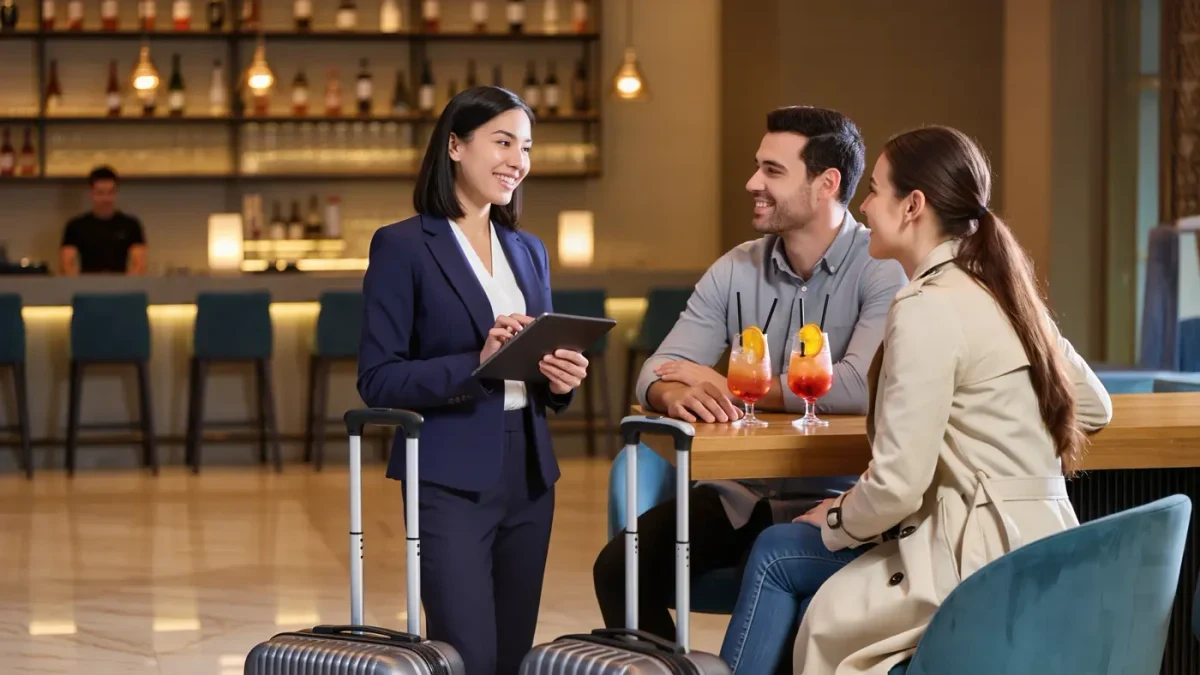
Hotels have been quietly dissolving the front desk: check-in happens at a bar stool with a welcome drink, at roaming staff tablets, at kiosks and phone keys, with the transactional desk reduced to a small service podium or eliminated — a shift hospitality trade coverage has tracked across lifestyle and luxury brands through the 2020s. The logic is both economic (the desk was expensive square footage devoted to a three-minute transaction) and experiential (arriving guests want a seat, a bathroom, and a sense of place, not a queue). The pandemic-era contactless habits finished what mobile keys started.
The desk's disappearance is also a small masterclass in service design, useful to anyone who hosts anyone.
What replaced the desk, exactly?
- Roving check-in: staff with tablets greet arrivals at the door or walk them to the bar; payment and ID handled standing or seated. The queue disappears into conversation.
- Hosted arrival rituals: a drink, a local map marked in pen, a two-minute orientation to the neighborhood instead of the Wi-Fi password speech — properties scripted arrival as hospitality rather than administration.
- Technology behind the scenes: mobile keys, pre-arrival registration, kiosks for the no-thanks-I'm-fine travelers. The desk didn't vanish; it distributed itself.
- The service pod: where a physical anchor remains, it's a two-person podium with sightlines to the door — staffed for problems, not for lines.
Why does it work better?
Because the desk misread the arrival. A traveler's first want is relief — off the street, oriented, seated. A queue in front of a counter reads institutional; a person with a tablet walking toward you reads welcome. Brands report the practical wins in trade coverage: shorter perceived waits, higher arrival-satisfaction scores, and lobby food-and-beverage revenue up, since the guest is now seated next to the bar with a drink instead of standing in a line facing away from it. The economics compound: the desk's footprint was the lobby's best real estate, and every square meter moved from queue to seating earns money instead of processing it.
Where it fails
The failures are instructive. Deskless without staffing: replacing the desk with an app but no humans converts a queue into an abandonment — the guest with a problem (wrong dates, lost key, bad room) needs a person, and a lobby with no anchor gives no one to find. Ritual without opt-out: business travelers at midnight want a key and silence, not a curated welcome; the best versions keep a fast lane. Hidden costs moved to guests: every task offloaded to a phone — keys, bills, requests — assumes a charged phone and a willing user; hotels that deskless-ed their older clientele into confusion walked some of it back. The lesson the industry keeps relearning: distribute the transaction, but never the accountability.
Related stories: Hotel lighting has lessons for every room in your house · Hotel bathroom design tricks worth stealing for your own.
What can a homeowner or host steal?
- Design the arrival, not the entryway: decide what a guest's first ninety seconds contain — a place for bags, a hook for the coat, a drink offered, orientation to the bathroom. The hospitality sequence scales to a hallway.
- Remove the queue: anything guests wait behind at your gathering — the drinks station, the bathroom line, the shoe pile — can be doubled or distributed. Two small stations beat one grand one.
- Pod, not desk: if you host often, keep one anchor spot — a console with corkscrew, glasses, charger, local info — that guests can find without asking, the domestic version of the service pod with sightlines to the door.
- Fast lane for the tired: the guest who wants to disappear to their room gets the key and the quiet. Offer the ritual; never require it.
Is the front desk coming back?
In pieces, yes — the 2020s' pendulum swung from deskless enthusiasm toward hybrid models: a small human anchor plus mobile everything, because the failure modes above proved expensive in reviews. What is not coming back is the counter-as-wall: the architecture of arrival now assumes the host comes to the guest. That assumption — service walks, transactions wait — is the durable design idea, and it costs nothing to adopt at any scale, from a forty-story hotel to a studio apartment hosting Thanksgiving.
FAQ
Why are hotels removing front desks?
Mobile keys and pre-arrival check-in removed the transaction the desk existed for, freeing prime lobby space for revenue-earning seating while improving arrival experience. Most brands kept a small staffed pod for problems, so the desk distributed rather than disappeared.
What is roving or seated check-in?
Staff with tablets greet arriving guests at the door or walk them to the bar or lounge, completing registration conversationally — eliminating the queue and starting the stay with hospitality rather than paperwork.
What did contactless hospitality change?
It normalized phone-based keys, bills, and requests, accelerating the desk's decline — but hotels that cut humans entirely walked some of it back, because guests with problems need a person. The durable model is mobile transactions plus a human anchor: service that walks to you, with technology waiting quietly behind it.
For more context, read Why hotel lobbies look like living rooms now.
For more context, read hotel breakfast room design.
For more context, read Lobby scent, and the materials that make memory.