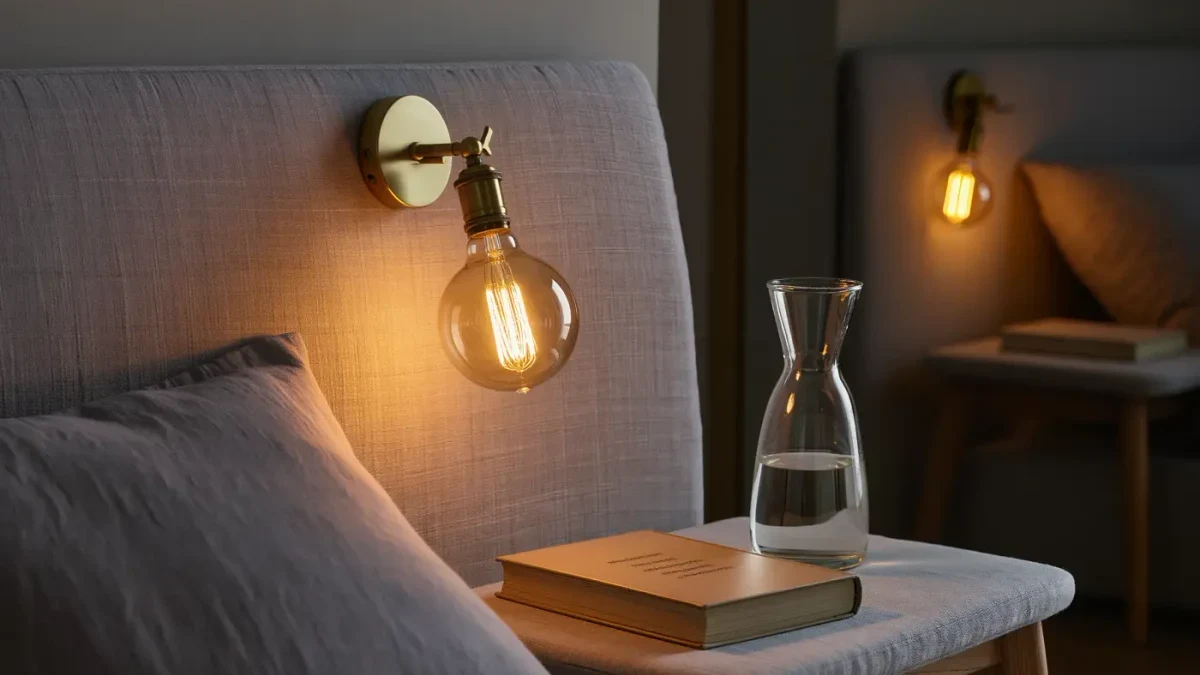
Hotel rooms flatter guests because designers never rely on a single overhead source: they layer light — task lamps by the bed, soft ambience at the walls, an accent on a texture, everything dimmable — and energy-efficiency guidance from the U.S. Department of Energy likewise recommends layered, task-based lighting as both the comfortable and efficient approach. The pattern is so consistent across good hotels that it functions as a recipe: four layers, warm color temperature, dimmers everywhere, and darkness you control. Copying it at home is mostly a matter of lamp placement and a screwdriver-grade dimmer swap.
Here is the recipe, room by room.
What are the four layers?
- Ambient: the base wash that lets you walk through — from pendants, ceiling fixtures, or bounced light. In hotels this layer is deliberately weak.
- Task: dedicated light where eyes work — bedside for reading, bedside-thirty-inches-high at a desk, under-cabinet in kitchens. One good task light per habit.
- Accent: light aimed at things worth looking at — art, a textured wall, the headboard, a plant. Hotels use this layer to tell you what the room is about.
- Decorative: fixtures whose light is almost incidental — the sculptural sconce is a lit object, adding sparkle at eye level.
The rule underneath: light the walls and the tasks, and the room lights itself; light only the floor from above, and the room reads like a parking garage with better towels.
Why is everything so warm and so dim?
Two numbers govern hotel mood. Color temperature around 2700K (warm white) — the color of filament light, which reads as evening and rest; hotel designers use 3000K in bathrooms where task clarity matters, and reserve anything cooler for gyms and back-of-house. Dimmability everywhere: a hotel room's day is two scenes — daytime bright enough to pack a suitcase, evening low enough to feel like a private dinner — and the difference is a dial. At home, the equivalent move is putting every fixture on a dimmer (check LED compatibility on both fixture and switch) and adding one lamp you actually turn on nightly.
Bedroom: the headboard trick
Hotel bedrooms place light behind or beside the headboard — sconces at 30 inches or so, or washes on the headboard wall — so the eye's resting view is a glow, not a ceiling fixture. Replicate with plug-in sconces (no electrician needed; many now come with cords disguised as design), two bedside lamps at reading height with warm bulbs, and nothing overhead except a cleaning-day scenario. The bedside rule of thumb from hotel standards: enough light to read a page comfortably while your partner sleeps — which means two independently switched sources, always.
Related stories: Why hotel check-in moved to the bar · Hotel bathroom design tricks worth stealing for your own.
Bathroom: face first
Hotel bathrooms light the face at the mirror — vertical sconces or backlit mirror at head height — because ceiling-only light carves eye shadows and reads institutional at 6 a.m. The full hotel sequence: warm task light at the glass, one soft ambient source, a night-level light (motion-LED at the toe-kick is the civilized version) so midnight visits never flip the full chandelier.
Living room: the triangle
Boutique lobbies and good suites arrange three light points in a rough triangle — floor lamp by the reading chair, table lamp on the console, accent on a shelf or wall — so seating areas feel surrounded rather than spotlit. Then the trick that costs nothing: place lamps so their glow lands on a wall or ceiling near where people sit, not on the floor between them. The eye reads the lit surfaces and calls the room bright even at low total lumens.
What should a homeowner buy first?
- Warm bulbs everywhere: swap any remaining cool white (4000K+) in living spaces for 2700K — the highest impact-per-dollar move in lighting.
- Two real bedside lamps with independent switches.
- A dimmer on the living room's main fixture (LED-rated).
- One picture light or uplight on something you love — the accent layer is what makes a room feel intentional.
FAQ
What color temperature should home lighting be?
2700K (warm white) for living rooms and bedrooms, 3000K acceptable in bathrooms and kitchens where task clarity helps. Reserve cool 4000K+ light for utility spaces — in living areas it reads clinical and works against evening relaxation.
How many light sources should a room have?
At least three, in a triangle: a floor or table lamp by a seat, a second at the room's other activity, and an accent on a wall or object — each dimmable or switched separately. Layered points beat one bright fixture for comfort at lower total energy.
Why do hotel rooms feel relaxing at night?
Warm color temperature, layered low light at eye level rather than overhead, and full dimming control — a deliberately weak ambient base with task light only where needed. All three copy to a house with plug-in lamps and dimmers.
For more context, read Hotel bathroom design tricks worth stealing for your own.
For more context, read spa bathroom design.
For more context, read Why hotel lobbies look like living rooms now.