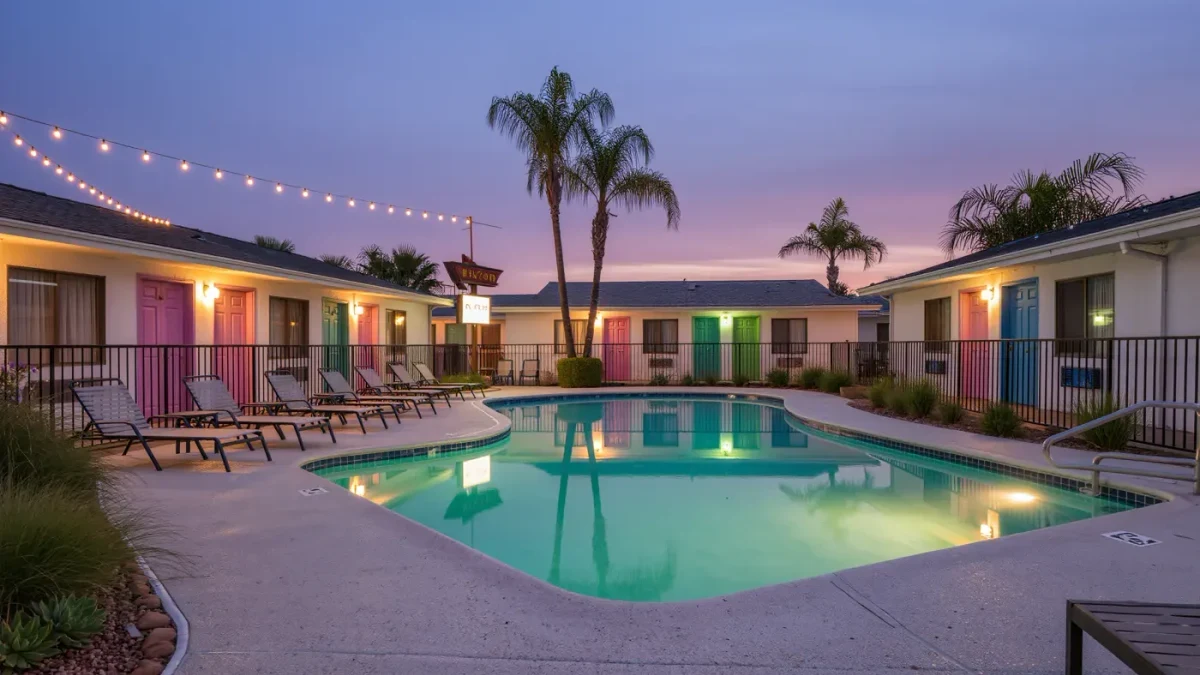
The mid-century American motel — one or two stories of rooms around a parking court, built for the two-lane highway era — is becoming one of hospitality's most reused building types: independents and small brands are converting them into design-forward boutique hotels with pools, restaurants, and courtyard social lives, while other operators rework them as monthly-stay housing. The pattern runs from Florida's springs-court motels to California desert retro-chick to Texas hill-country revivals, and it follows a durable logic: the buildings sit on valuable road-front land, their structure is simple and sound, and their layout around a courtyard suits exactly the social-outdoor life travelers now pay for.
The motel was always hospitality's most honest format — a room, a door, a parking space. Revivalists just added the part it never had: a reason to stay.
Why do motels convert so well?
Three structural gifts. Every room already has independent access — no double-loaded corridors to rebuild, and post-pandemic travelers still like a door that opens to air. The parking court converts to the amenity core: pool, fire pit, outdoor bar, lawn games — the court becomes the hotel's living room at a fraction of a new-build's cost. And the buildings are modest in scale, letting operators keep the period character — terrazzo floors, pastel bathroom tile, the neon sign — that new construction fake at great expense. Preservationists note that mid-century motel signs have become landmarks in their own right; the Library of Congress's roadside-America collections document the type's golden age from the late 1940s through the 1960s.
What does a good conversion change — and keep?
- Keep: the court geometry, the independent doors, the sign (restored neon reads as pedigree), period bathroom tile where sound, and the low scale that lets every room face the pool.
- Change: bathrooms and insulation brought to modern standard, HVAC individualized and quieted, lighting layered, wifi rebuilt as infrastructure, and the office/lobby turned into a bar-coffee-reception hybrid — the motel-version of the living-room lobby.
- Add: the food-and-drink anchor, landscaping that makes the court a destination rather than a turnaround, and often a small retail or vinyl corner that gives locals a reason to walk in.
Related stories: Why hotel check-in moved to the bar · Hotel bathroom design tricks worth stealing for your own.
What are the economics?
Conversion typically lands below new-construction cost per key — the structure, utilities, and site already exist — and the period character commands rate premiums no new-build budget motel could ask. The risks are the boring ones: zoning that restricts food service or alcohol on old highway parcels, parking-minimum math when the court fills with pool and patio, utility upgrades for 1950s service, and franchise-era boxes (the 1980s exterior-corridor chain motels) that have no character to keep and rarely justify the premium path — those trend instead toward the housing conversion below. Location decides the ceiling: a revived motel works where traveler demand or a neighborhood's dining scene already exists, not as a rescue plan for a bypassed road.
And the housing version?
The quieter half of the story: motels as apartments. Cities confronting housing shortages have supported nonprofit and public conversions of extended-stay and motel stock into transitional and permanent supportive housing — single-room buildings with private baths convert well, and hundreds of such projects have opened across the country over the past decade. It is the same structural honesty serving a different crisis: a room with its own door and bathroom is, in fact, a home's minimum viable product. The design challenges — kitchens, case management space, common rooms — are tractable, and the format has become a recognized tool in housing policy discussions through the mid-2020s.
What should a traveler or a buyer take from it?
Traveler: the best conversions compete with four-star boutiques on atmosphere while keeping a period friendliness chains cannot manufacture — book the court-facing room, and check whether the sign is original (it usually tells you how seriously the rest was done). Investor or developer: diligence the zoning before the romance — food service, alcohol, and event use are the permits that make or break the boutique model, and the utility assessment is the budget's hiding place. Either way, the type's second act is a lesson in reuse economics: the greenest building keeps proving to be the one already standing.
FAQ
Why are old motels being converted?
They occupy valuable road-front land with simple, sound structures and courtyard layouts that suit both boutique hotels — doors to open air, a court that becomes the pool-social core — and monthly housing, often at well below new-build cost per room.
Are motel conversions cheaper than new hotels?
Generally yes per key, because structure, site, and utilities exist. But zoning limits on food and alcohol, parking requirements, and 1950s-era utility upgrades are where budgets quietly grow — diligence those first.
Can motels really become housing?
Yes — single-room buildings with private bathrooms convert efficiently to transitional and supportive housing, and hundreds of such conversions have opened across the U.S. over the past decade, often with nonprofit or public support.
For more context, read How an office tower turns into a hotel, floor by floor.
For more context, read hotel breakfast room design.
For more context, read Why hotel lobbies look like living rooms now.