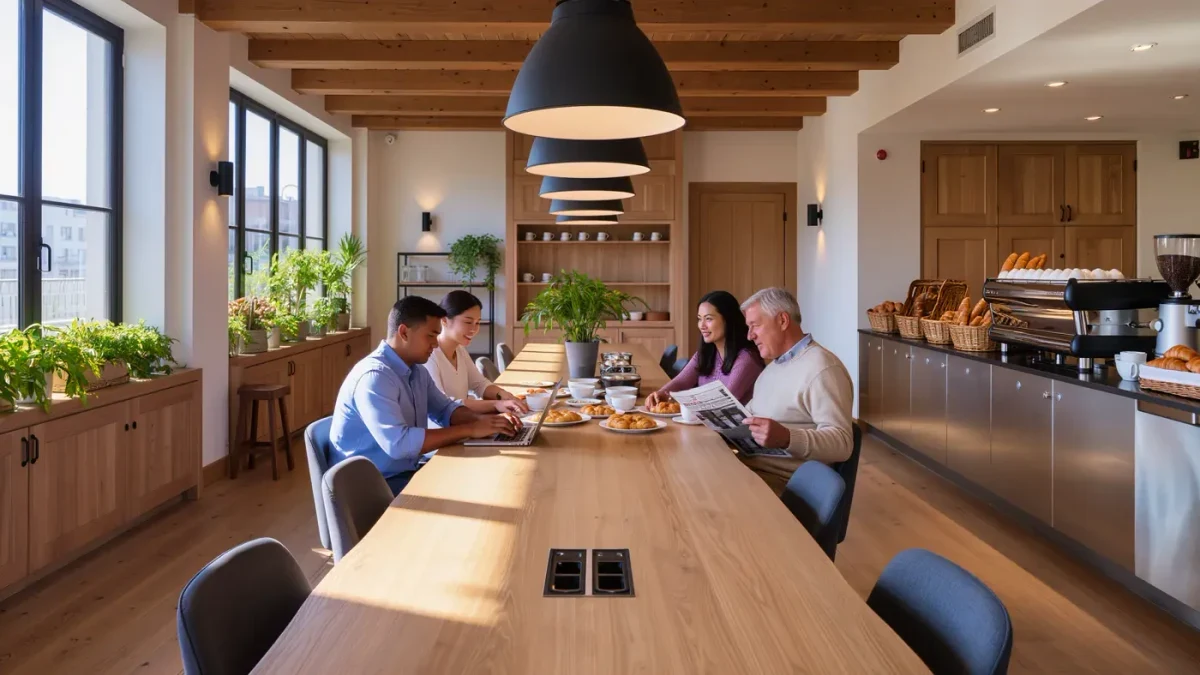
The hotel breakfast room — once a fluorescent afterthought by the service elevator — has become the most deliberately designed space in mid-market and boutique hotels: communal tables, bar seating with outlets, espresso stations visible from the street through glass walls, and layouts borrowed from coworking because that is how guests now use them. Hospitality trade coverage through the 2020s documents the shift across brand tiers, and the logic is straightforward operational math: breakfast is the highest-attendance moment of the guest day (essentially every guest, every morning, within a two-hour window), which makes the breakfast room the property's most-used space per square meter — and designers finally started spending on it accordingly.
The redesign also quietly rebuilt the lobby's economics around morning.
What changed in the room itself?
- From queue to zone: the old line-to-table flow became stations — coffee here, hot items there, grab-and-go at the door — mirroring how commercial kitchens stage throughput; the room now handles the 8:15 rush without the 8:15 line.
- The communal table: long shared tables (the hospitality borrowing from libraries and coworking) turned solo travelers' breakfast from isolation into optional society — a third place (not home, not work) that hotels previously offered only in the bar.
- Work surfaces: outlets, laptop ledges, and morning-proof lighting; the guest having coffee and email at 7:30 is now designed for, not tolerated.
- Local identity on the plate and walls: regional pastries, local roasters, neighborhood photography — breakfast is where a chain proves it isn't one.
- The street connection: glass walls opening the breakfast room to the sidewalk, letting the coffee aroma advertise the hotel to passers-by all morning.
Why mornings pay for the building
Attendance is only half of it. Breakfast is the moment guests form the review: a strong first morning colors the whole stay's perception — hoteliers' operational wisdom treats the breakfast room as the property's front page. It is also the retention machine: loyalty tiers are built around breakfast benefits, and direct-booking incentives (skip the third-party commission, get the eggs) quietly route revenue through those morning plates. And the space earns twice: by 10:30 it converts — coworking lounge by day, bar or event space by evening. The modern breakfast room is designed less as a dining room than as a multipurpose hall whose first act is eggs.
Related stories: Why hotel lobbies look like living rooms now · Why hotel check-in moved to the bar.
What can a homeowner or host steal?
- Design your kitchen for the 8:15 problem: stage the morning like a hotel stations plan — coffee station, toast station, exits — so two adults can leave in parallel instead of in series.
- One communal surface: the long table does more social work than four small ones; it is the cheapest hospitality upgrade in any home.
- Outlets where people sit: the hotel lesson is that a surface without power is furniture; add a strip to the breakfast nook and watch it become the house's favorite desk.
- The visible coffee ritual: a real machine, visible, with real cups — the smell of morning coffee is the most cost-effective interior design ever commercialized.
- Local on the table: the boutique trick works at home — the neighborhood bakery's bread makes breakfast feel chosen rather than assembled.
Where the trend fails
The failure modes are familiar from every trend cycle: the communal table with no option for the couple who wanted quiet; the "grab-and-go" that means a cooler and a shrug; the beautiful space staffed for failure at 8:15 when the waffle iron queue defeats the architecture; and the glass-walled room on a north-facing street that trades privacy for a view of a parking structure. The discipline is the same one good hotels apply everywhere: design the operation, then the room. A breakfast space is a machine for mornings with hospitality applied — style the machine first, the marble second.
FAQ
Why do hotels put so much design into breakfast areas now?
Breakfast draws essentially every guest daily within a two-hour window — the highest-attendance, highest-review-impact moment of the stay — and the space doubles as coworking lounge and evening venue. Per square meter, it is the hotel's hardest-working room.
What is a third place?
A social setting that is neither home nor work — cafés, bars, libraries — where community happens informally. Hotels now build third-place moments into breakfast rooms and lobbies, serving both guests and locals.
How should I design a breakfast area at home?
Steal the stations: coffee, toast, and exits staged so two people move in parallel; one long communal table with reachable outlets; a visible, quality coffee setup; and one local item on the table. The hotel tricks are scale-free.
For more context, read Why hotel lobbies look like living rooms now.
For more context, read hotel front desk design.
For more context, read Lobby scent, and the materials that make memory.