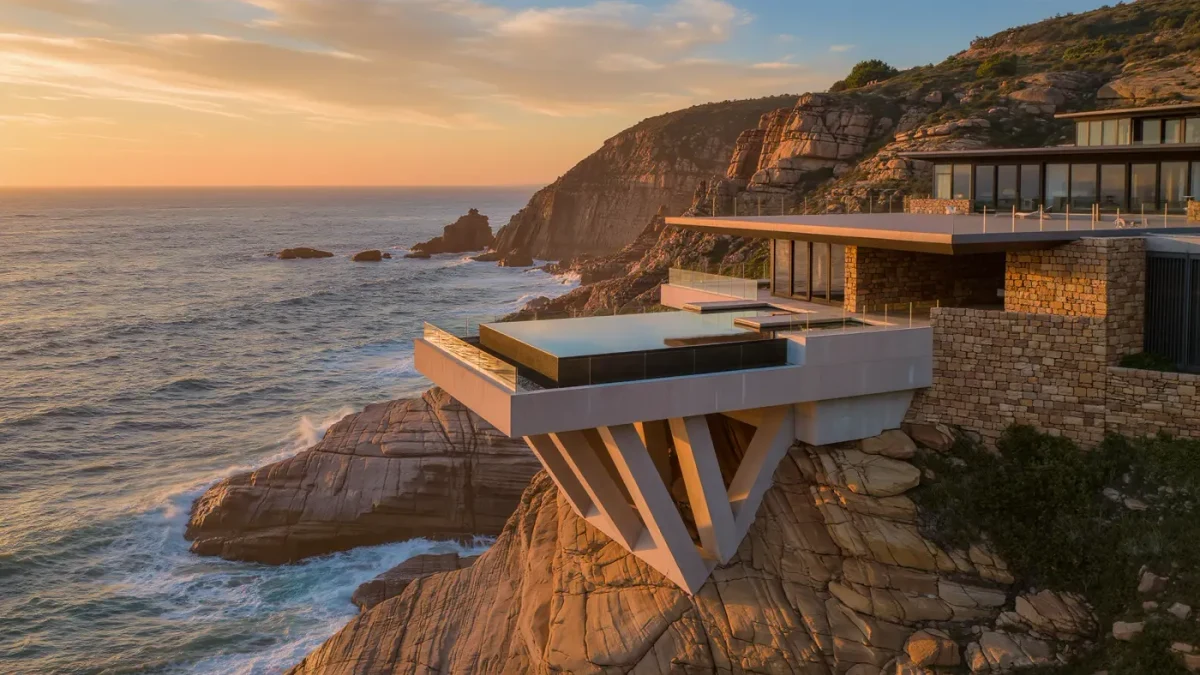
Cliffside resorts — the Amalfi hotels stacked above the Mediterranean, Big Sur's lodges on California's coastal escarpment, Utah's canyon-perched retreats — are the hospitality industry's most literal premium on location: the same room, moved ten meters back from the edge, is worth less. Building them is an exercise in geotechnical engineering disguised as interior design: post-tensioned concrete anchored into rock, micropiles drilled where ordinary foundations cannot go, and drainage systems managing the water that eventually decides every slope's fate. The engineering reports are the least photographed and most important design documents at these properties.
What keeps hotels on the edge up there is a short list of hard techniques — and they translate, in miniature, to every hillside home.
Why build on a cliff at all?
The product is the view plus the drama of the void — hospitality sells memory, and rooms over a drop are unforgettable by construction. But the economics run both ways: the site's difficulty caps how big and how cheap a building can be, so cliffside properties skew luxury by necessity — the engineering premium is only payable in the rate band where the view premium lives. The same logic explains hillside housing generally: steep sites are the last land developed in a market because they are the last land that pencils.
What holds these buildings up?
- Rock anchors and rock bolts: steel tendons grouted into sound rock, tensioning the structure to the cliff itself — the primary technique where solid rock exists near the surface.
- Micropiles: slender, steel-cased piles drilled deep through unstable surface layers to competent strata; they support loads where a spread footing would just surf the slope.
- Post-tensioned concrete: slabs and beams internally cable-stressed so cantilevers can reach out over the drop — the structural gymnastics behind every infinity pool that appears to pour off the cliff.
- Terracing and tiebacks: the Mediterranean method — stacked stone retaining walls holding imported soil, each terrace a small negotiated truce with gravity, plus modern soil nails and shotcrete behind the scenery.
- Water management: the unglamorous hero. Water is what moves slopes — surface drainage, interceptors above the site, and managed infiltration keep the cliff's internal strength intact. Most slope failures are drainage failures wearing a geology costume.
Related stories: Hotel breakfast spaces became the new lobby — on purpose · Hotel bathroom design tricks worth stealing for your own.
What are the failure stories?
Coastal California's bluff-retreat record is the standard cautionary dataset: bluffs lose incrementally to erosion, and oceanfront structures on them live on borrowed geometry — public coastal-management agencies map retreat rates precisely because buildings do not slow the ocean, they merely negotiate with it. Landslide history adds the second lesson: development atop ancient slide masses — the anthropogenic landslide crisis of 1950s–70s Los Angeles hillside building is the canonical case — showed that watering slopes, cutting them, and loading them can reactivate geology that had been quiet for millennia. The modern cliffside resort respects these records with the instrumentation era's answer: slope monitoring, movement sensors, and mandatory geotechnical review that older sites never had.
What does the guest experience look like from the engineering side?
The tricks that make cliffside stays feel the way they do are structural. Infinity pools cantilever so the water's edge meets the horizon — possible only with post-tensioned decks. Rooms step with the topography rather than fighting it, which is why cliffside hotels have such idiosyncratic floor plans and so many split-level entries. Balustrades and glass guards do invisible duty: the drama requires the void to feel near, so the safety engineering concentrates in slender, high-strength barriers — the most engineered railings in hospitality. And the access problem — funiculars, cliff elevators, serpentine drives — becomes an amenity, the arrival staged as descent.
What should a hillside homeowner take from it?
Three portable rules. Water is the enemy: manage roof, path, and slope drainage before anything else; most hillside problems arrive as water first and movement second. Do not load or cut without a geotechnical engineer: pools, additions, and regrading change the slope's arithmetic — the cheap report beats the expensive repair. Maintain what previous engineers installed: hillside homes inherit drainage systems, tiebacks, and terraces whose failure modes are quiet until they are not; an as-built drawing set in the garage is worth more than a renovation fund. The edge makes great hospitality and demanding homeownership — in both cases, the view is financed by the engineering nobody photographs.
FAQ
How do they build hotels on cliffs?
With rock anchors and bolts grouted into sound stone, micropiles drilled to competent strata, post-tensioned concrete cantilevers, terracing or tiebacks — and, decisively, engineered drainage, since water is what ultimately moves slopes.
Are cliffside hotels safe?
Modern ones are engineered with geotechnical investigation, monitoring, and instrumentation — the risk concentrates at older sites and eroding coastal bluffs, where public agencies map retreat rates and structures live on finite geometry.
What should hillside homeowners worry about most?
Water first: unmanaged drainage drives most slope movement. Then loading — pools, additions, and regrading need a geotechnical engineer's input — and finally maintenance of inherited systems like tiebacks and terraces whose failures are quiet until they aren't.
For more context, read Hotel breakfast spaces became the new lobby — on purpose.
For more context, read hotel signature scent.
For more context, read How an office tower turns into a hotel, floor by floor.