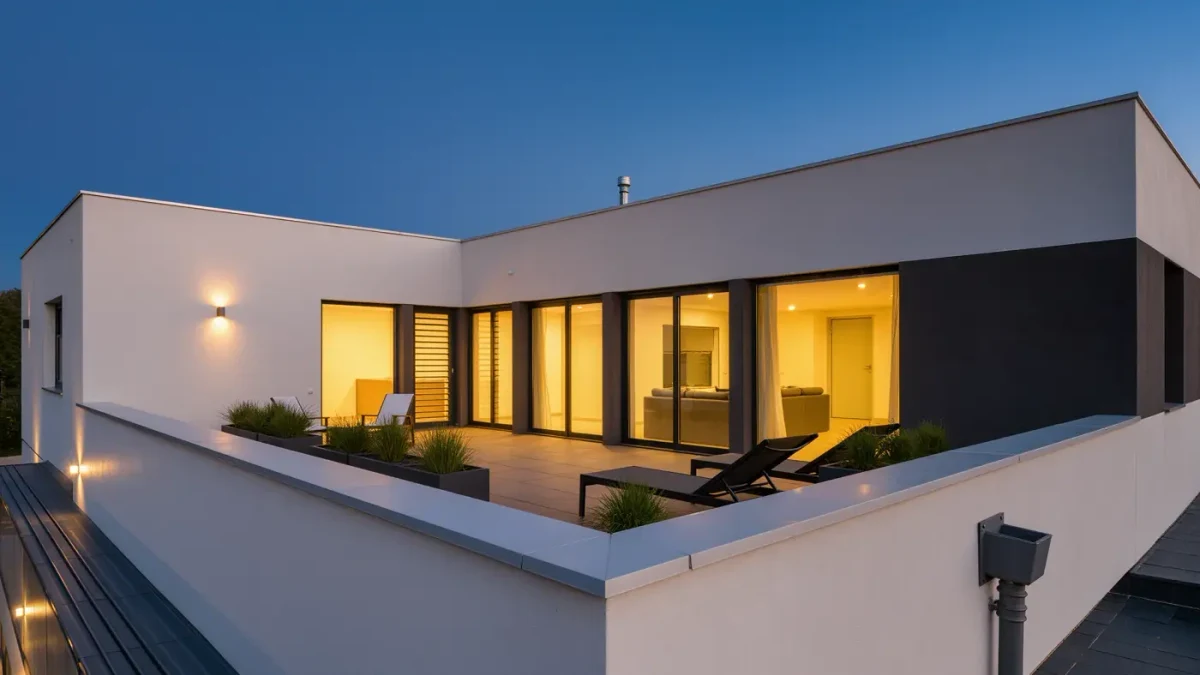
A "flat" roof is a misnomer that explains its own failures: a functional low-slope roof is built with a minimum pitch of roughly 1/4 inch per foot — about 2 percent — so water travels to drains rather than pooling, per industry standards from the National Roofing Contractors Association. When that slope is omitted, sagged, or blocked at the drain, water stands, and standing water is what actually destroys flat roofs — ultraviolet exposure and freeze-thaw cycles finishing the job. Architects keep specifying low-slope roofs because they enable roof terraces, clean parapet lines, mid-floor outdoor rooms, and simple mechanical mounting; the leaks are a construction-quality problem wearing a design-type costume.
The type's reputation was earned honestly and is fixable with knowledge. (This article publishes information, not construction advice.)
Why do flat roofs actually leak?
Four mechanisms, in order of frequency. Drainage failure: clogged scuppers and drains leaf water into ponds; a roof that holds water 48 hours after rain is failing by definition in most standards. Flashing and termination failures: wherever the membrane meets a wall, pipe, skylight, or parapet, a joint exists, and joints are where water enters — improper base-and-counter flashing is the most common repair call. Membrane aging: asphalt-based systems embrittle under UV; a 20-year-old built-up roof is at end of life regardless of care. Walking damage: flat roofs invite traffic — HVAC techs, holiday decorators, teenagers — and membrane punctures follow. Pitched roofs fail too, but their failures are visible from the yard; flat roofs fail in secret, which is the type's real design flaw.
What are the modern membrane systems?
| System | Lifespan | Character |
|---|---|---|
| Built-up (BUR, tar-and-gravel) | 20–30 yrs | The classic; heavy, durable, smelly to install |
| Modified bitumen (torch/peel) | 20 yrs | Common on homes; repairable |
| EPDM rubber | 20–30 yrs | Single-ply; seams are the watch point |
| TPO / PVC | 20–30 yrs | White, reflective, heat-welded seams |
All four work when installed with the right slope, drainage, and flashing; all four leak when they are not. The membrane choice matters less than the roofer — the industry's own guidance says most failures trace to installation, not product.
Related stories: Why architects love cross-laminated timber · What makes a building Brutalist, and why people pay to live in them.
Why do architects keep choosing them?
Because the flat roof buys things a pitched roof cannot. Usable roof: terraces, gardens, and decks — outdoor rooms above grade in dense sites. Form: the horizontal line is the grammar of modernism from the 1920s to now; a parapet hides mechanicals and gives the building a clean crown. Interior geometry: flat ceilings, no attic volume sacrificed to triangle gables, simpler upper-floor plans. Solar-ready surfaces: panel arrays mount low and read clean. The trade is honest: architecture gained the horizontal and accepted a roof that behaves like a machine — one with maintenance schedules.
What does maintenance actually require?
- Twice-yearly inspections (spring after snow, fall after leaves): clear drains and scuppers, check flashing, look for ponding patterns in dirt deposits.
- After any contractor visit: walk the roof for dropped fasteners and punctures — the ten-minute check that prevents the five-year leak.
- Resurfacing on schedule: elastomeric coatings extend membrane life cheaply; re-coat before failure, not after the ceiling stain.
- Keep a roof plan: know where your drains are and where water should travel; when re-roofing, add slope with tapered insulation rather than accepting the pond.
What should a buyer do with a flat-roofed house?
Ask three questions at inspection. Age of membrane and its type (the inspector can usually identify both)? Evidence of ponding — dirt rings, silt fans at drains? Where does water go — are there overflow scuppers sized for a blocked primary drain? Budget knowing the lifecycle: a flat roof is a 20-to-30-year component, cheaper to replace per event than a pitched roof but more frequent, and its condition is direct price-adjustment material in an offer. And if you are building or re-roofing: pay for the tapered insulation and the oversized drains. The flat roof's bad reputation is, at root, a deferred-maintenance ledger — the design just keeps better secrets than a shingle.
FAQ
Are flat roofs really flat?
No — they are low-slope roofs built at roughly 1/4 inch per foot minimum so water drains. Leaks most often trace to inadequate slope, blocked drains, or failed flashing rather than the concept itself.
How long does a flat roof last?
Roughly 20 to 30 years for modern systems (BUR, modified bitumen, EPDM, TPO/PVC), with elastomeric re-coating extending life. Installation quality and drainage maintenance matter more than membrane brand.
What maintenance does a flat roof need?
Twice-yearly drain and flashing checks, puncture walks after any rooftop contractor visit, and re-coating before membrane failure. Ponding water 48 hours after rain signals a drainage problem needing correction.
For more context, read What makes a building Brutalist, and why people pay to live in them.
For more context, read glass block.
For more context, read The prefab house arrives in pieces on purpose.