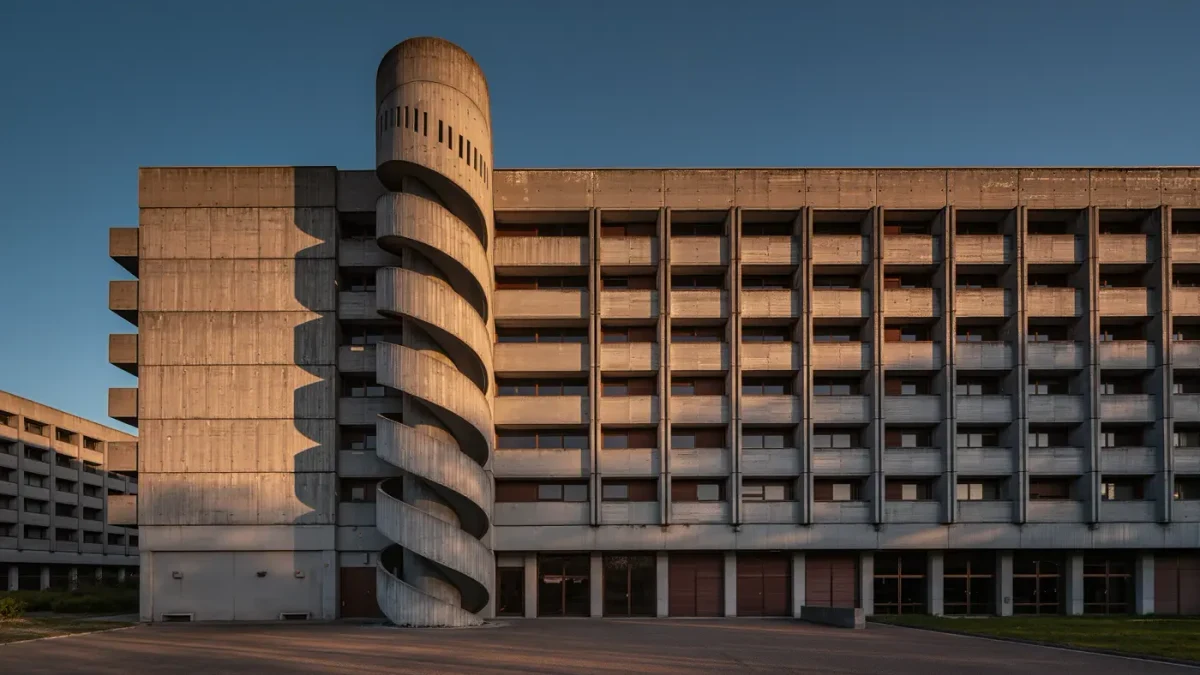
Brutalism is the mid-twentieth-century architecture of raw, exposed structural material — chiefly board-formed concrete showing the grain of its wooden molds — organized into heroic, sculptural masses; the name comes from béton brut, Le Corbusier's term for raw concrete, not from any brutality, and the style's American peak ran roughly from the late 1950s through the 1970s in civic centers, universities, and housing. The residential examples — Boston's concrete towers, London's council estates, New York's university-adjacent slabs — spent decades as punchlines and have spent the last fifteen years as design-culture icons and, increasingly, desirable addresses. The buildings did not change; the audience did.
What did not change matters more: how they are built, and what living in one is actually like.
How do you recognize one, precisely?
Four tells. Material honesty: concrete left as concrete, its tie-holes and formwork seams visible — the surface is the structure is the facade. Mass and shadow: instead of decorated surfaces, the design interest comes from deep recesses, projecting slabs, and geometric repetition that produces dramatic shadow patterns as the sun moves. Expressed structure and program: the building shows its bones — stair towers as separate cylinders, service zones expressed on the exterior, windows banded between slabs. Ground-floor reciprocity: the better examples lift the building on piers or open the podium to public use; the worst turn their backs with blank walls — Brutalism's reputation tracks this single design move more than any other.
Why did Brutalism get so hated?
Three converging stories. Association: in the U.S. and Britain, the style was the face of 1960s urban renewal — concrete civic centers and public housing built amid demolition of established neighborhoods, so the architecture absorbed the politics. Maintenance: exposed concrete weathers visibly, and public owners often deferred the cleaning and repointing that keeps it dignified; a stained Brutalist building photographs as hostile. Fashion: postmodernism's 1980s campaign defined the style as everything wrong with modernism. The rehabilitation ran the same channels in reverse — photography culture loved the geometry, preservationists documented the craft (the Library of Congress's survey collections include significant Brutalist works), and a generation raised on the buildings' video-game and film appearances read them as texture rather than threat.
Related stories: Why architects love cross-laminated timber · Why flat roofs leak, and architects use them anyway.
What are they like to live in?
The honest ledger, from residents' accounts of the converted and purpose-built towers. Assets: structural concrete means quiet — the party-and-stack construction kills footfall and street noise in a way wood-frame never will; deep reveals give windows a solar buffer and a framed view; ceiling heights in the genre's better housing (much of it built to generous mid-century public standards) run tall; and the unit counts of towers mean real amenities and views at prices the glass-condo market cannot touch. Liabilities: thermal mass cuts both ways — slow to heat, slow to cool, and uninsulated concrete performs poorly by modern energy codes, so conversions confront expensive envelope work; the aesthetic is an acquired taste your guests may not acquire; window replacement in a heritage concrete facade is a negotiation; and single-aspect slabs can produce long, dark interior plans in the wrong conversions.
Why do they now command premiums?
Scarcity plus narrative. The style's window was twenty years and its enemies were energetic — many examples were demolished, and preservation battles (Chicago's Prentice Hospital, Goshen's Government Center) became cause célèbres that raised the profile of survivors. Design-literate renters price the authenticity: real material, real structure, unrepeatable — the opposite of the interchangeable luxury finish. And adaptive reuse economics help: a solid concrete frame is exactly the durable shell converters prize, which is why office and civic Brutalism keeps finding second lives as housing, with units marketed on the concrete itself — the once-shameful surface now the listing's hero photograph.
What should a renter or buyer check?
- The envelope's renovation status: has anyone insulated, re-glazed, or sealed? Ask for winter utility ranges — thermal mass without upgrades runs expensive.
- Orientation and depth: which way does your slab face, and how far is the window wall from the corridor? Daylight in these plans is directional.
- Heritage controls: landmarked Brutalism constrains exterior changes — read the designation before planning a balcony herb garden.
- Water history: concrete flat roofs and exposed slabs have joints; ask about envelope surveys and the reserve fund's envelope line.
FAQ
Why is it called Brutalism?
From béton brut — French for raw concrete, Le Corbusier's term for concrete left exposed with its formwork texture. The name describes material honesty, not aggression, though the misunderstanding shaped the style's reputation.
Are Brutalist buildings energy efficient?
Generally no as originally built — uninsulated concrete transfers heat readily, though its thermal mass smooths swings. Modern conversions add insulation, glazing, and mechanical upgrades; ask for actual utility costs before renting or buying.
Why is Brutalism popular again?
Photogenic geometry, a preservation movement that made survivors famous, and a design culture that prizes authentic material over interchangeable finishes. Converted concrete frames also suit adaptive reuse economics — durable structure, generous floor plates.
For more context, read Why architects love cross-laminated timber.
For more context, read glass block.
For more context, read How a church becomes apartments.