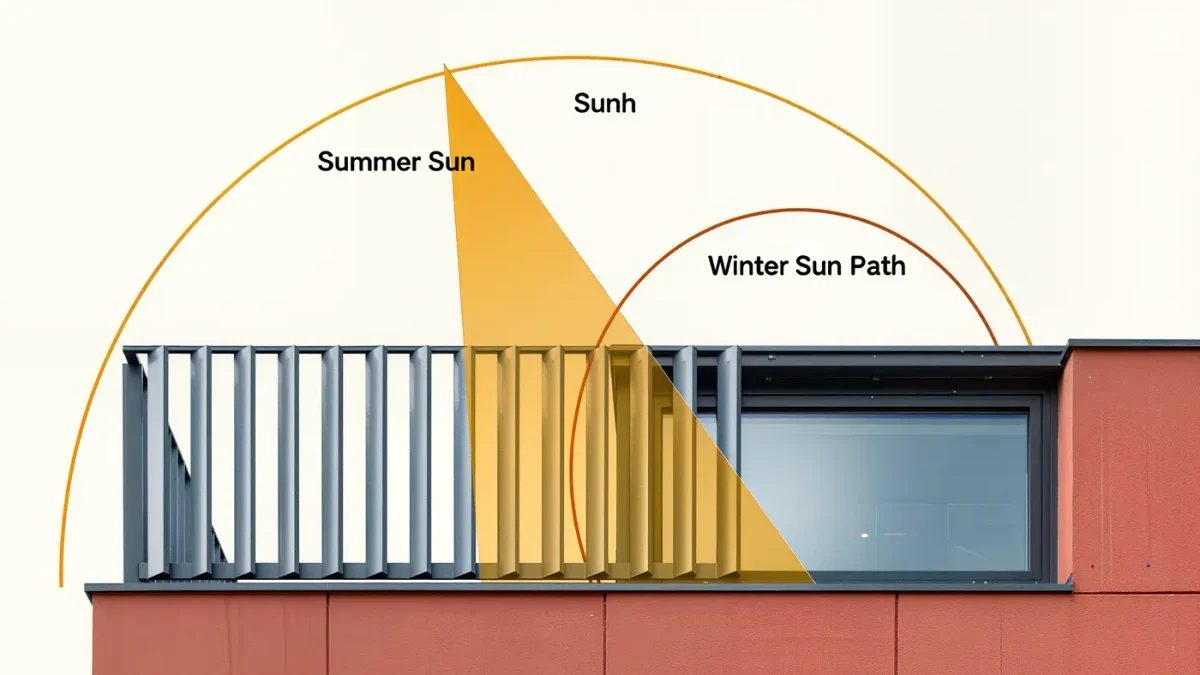
A brise-soleil (literally "sun-breaker" in French) is an exterior shading structure — fins, louvers, screens, or a perforated skin — fixed to a building's facade to block high summer sun while letting low winter sun in. Modern versions on apartment buildings from Miami to Phoenix cut cooling loads measurably, and per the U.S. Department of Energy, properly designed exterior shading can reduce solar heat gain through windows by up to 80 percent before the heat ever reaches the glass.
It is architecture doing with geometry what most buildings try to do with electricity. And once you can name it, you start seeing it everywhere.
Where did the idea come from?
The term and the craft trace to mid-century modernism. French-Swiss architect Le Corbusier, working in hot climates, developed the brise-soleil in the 1930s for projects in North and South America; his Ministry of Education building in Rio de Janeiro, designed with Brazilian colleagues, made an adjustable louvred screen the entire south facade. Brazilian architect Lúcio Costa led the design team, and Oscar Niemeyer worked on it — a who's-who of modernism collaborating on what was, at heart, a giant sunshade.
The idea predates the modernists by millennia, of course. Deep overhangs on adobe houses, lattice screens on buildings across the Middle East and North Africa, verandas in the American South — every hot-climate building tradition invented its own version. Modernism's contribution was to make the sunscreen the building's face instead of its hat.
Why is it coming back now?
Two pressures converged. Energy codes tightened: whole-building performance standards in cities like New York and states like California now reward designs that avoid heat rather than mechanically removing it. And heat itself got worse — longer, hotter summers across the southern and southwestern U.S. pushed cooling from a comfort line item to a survival budget.
Exterior shading is uniquely honest architecture: it is a mechanism you can see. A brise-soleil casts stripes across a living room floor that migrate with the seasons, and residents learn the building's rhythm the way a farmer reads a sky.
How does the geometry actually work?
The trick is the angle of the sun. In summer, the sun rides high — around 70 to 80 degrees above the horizon at midday in much of the U.S. — so horizontal fins or a deep overhang intercept it. In winter, the sun crawls at 25 to 40 degrees, sliding under the fins and reaching deep into a room exactly when free warmth is welcome. A fixed screen designed for the building's latitude needs no motors, no sensors, no maintenance contract. It just blocks the right sun by standing still.
- Horizontal fins suit south-facing facades, blocking high noon sun.
- Vertical fins suit east and west faces, where low morning and evening sun slides sideways.
- Eggcrate screens (both directions) suit harsh exposures like desert west walls.
- Perforated metal skins wrap the whole building, doubling as balustrade and privacy layer on balconies.
Related stories: Courtyard apartments: the quiet alternative to the tower · Why glass block keeps coming back.
What does it change for the people inside?
Three things a resident feels. First, comfort stops depending on the thermostat: shaded glass means the armchair by the window is usable in July. Second, daylight survives — a good screen cuts glare and heat while keeping the view and the diffused light, which blinds and tinted glass do not manage as gracefully. Third, the facade gives the building a texture that ages well; the shadow patterns do the decorating, so the interior can stay calm.
The costs are honest too: screens collect dust and pigeons in some climates, and a badly angled louver can whistle in wind. Like anything structural, the first-year design matters more than the brochure.
How is it different from all the other shading words?
Real estate copy mixes these up constantly. A brise-soleil is fixed to the building's exterior. A louver is a single slatted element, adjustable or fixed — often one fin within a brise-soleil. A pergola is a freestanding or attached open frame, usually over a terrace. An awning is fabric and retractable. A shadow box or second skin facade is a full outer layer of glass or metal held off the main wall, creating a ventilated cavity. If a listing says "brise-soleil balconies," look at the photos: you want to see fins or screens that are clearly structural and clearly shading glass, not a decorative grille glued beside a window.
Should a home buyer care?
If you are buying in a hot climate, yes — shading is a monthly bill wearing a costume. A west-facing glass wall with no exterior protection in Phoenix or Austin is a signature on a summer electric bill; the same wall behind even a modest screen reads 10 to 20 degrees cooler at the glass. Walk any apartment you are considering at 4 p.m. in summer and stand by the window. The difference between a shaded and unshaded room is something your forearm will measure before your brain does.
And if you are renovating, the logic ports to a house scale: deep porch, pergola, external shutters. The old technologies are winning again because the problem they solve never went away — the sun did not get more polite, but the buildings did get more glass.
FAQ
Does a brise-soleil block the view?
A well-designed one frames the view rather than blocking it. Perforated screens and spaced fins preserve most sightlines while cutting direct sun; standing back from the screen, residents typically see through it cleanly, and the dappled light it produces replaces the harsh glare of bare glass.
Is it only for hot climates?
No. In temperate climates brise-soleil is tuned to seasonal angles — blocking high summer sun while admitting low winter light for free heating. Even northern cities use them to control glare and west-facing overheating, a growing problem as summers warm.
Can I add shading to an existing house?
Yes, at smaller scales: external shutters, awnings, a deep pergola, or a cantilevered trellis all follow the same principle. Exterior shading beats interior blinds because it stops solar heat before it enters the glass — the Department of Energy's guidance is consistent on that ordering.
For more context, read Why glass block keeps coming back.
For more context, read double height living room.
For more context, read brutalist architecture.