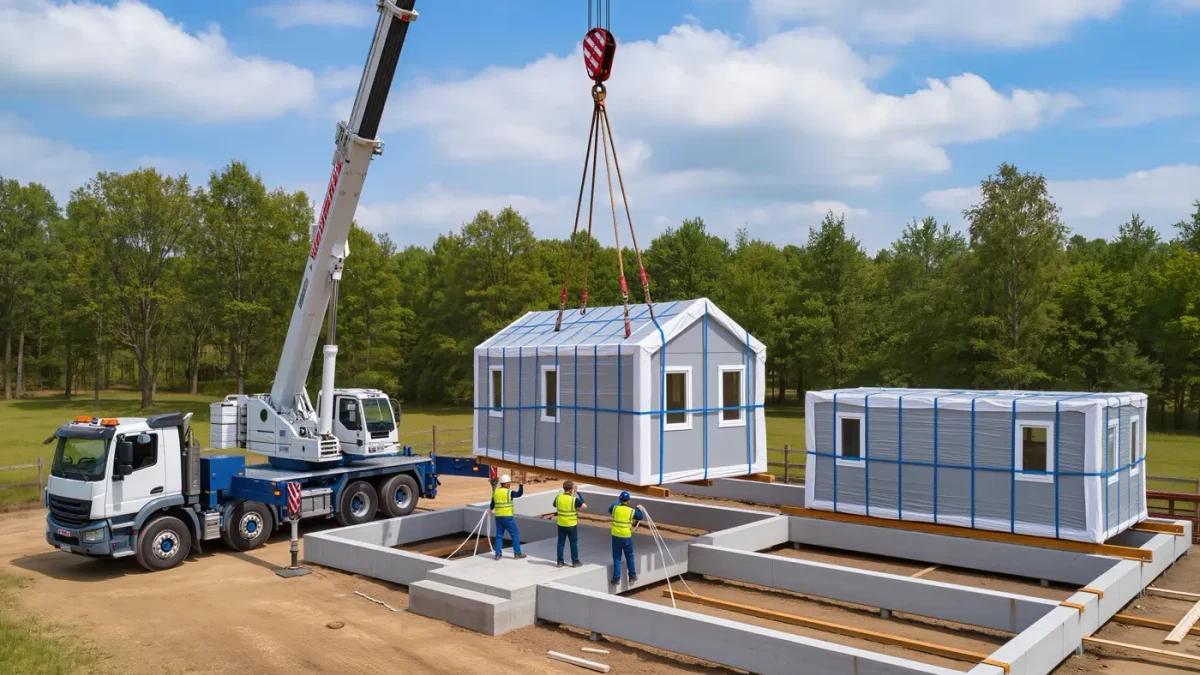
A prefab (prefabricated) house is built in a factory as modules or panels, trucked to the site, and assembled on a foundation in days: a typical two-module home leaves the factory 80-plus percent complete — walls, windows, finishes, even cabinets — and closes up weather-tight the week it arrives. Factory building is no longer fringe: the modular segment of U.S. construction grew through the 2020s as labor shortages squeezed site builders, and per the Modular Building Institute, offsite methods now account for a meaningful and rising share of single-family and multifamily construction — the industry's quiet answer to its own productivity problem.
The pieces arrive on purpose, and the reasons are mostly arithmetic.
What are the actual types?
- Modular: whole room-sized boxes, built to state and local building codes, craned onto the foundation and stitched together — the closest experience to a site-built house.
- Panelized: flat walls and roof trusses shipped for site assembly — more transport-efficient, more site labor.
- Kits and package homes: engineered component sets, from Sears-catalogheirloom tradition to modern SIP (structural insulated panel) packages.
- Manufactured homes: built to the federal HUD code on a permanent chassis — a separate regulatory category, often mislabeled "modular"; the financing and zoning rules differ, so know which you are buying.
Why build in a factory?
Four compounding advantages. Labor: one crew in a climate-controlled plant outproduces site framer teams competing for scarce trades. Weather: materials never soak; schedules run to the calendar, not the forecast — site-built lumber absorbs moisture and dries into the walls, a durability liability factories simply delete. Tolerances: jigs and repeatable assemblies mean straighter, tighter, more airtight envelopes — factory building suits high-performance (passive-house-grade) construction because quality control is repeatable. Speed: foundation proceeds on site while the house builds in the plant; the classic two-parallel-tracks schedule compresses a year to a few months.
What does it cost, really?
The honest answer: prefab is not automatically cheaper. The box itself is price-competitive per square foot with quality site building; the total budget then runs through the same site costs — land, foundation, utilities, permits, transportation of the modules (a real line item that grows with distance and route complexity), crane day, and the on-site finishing (utility connections, porch, driveway, landscaping). Where prefab reliably wins is time-to-finished-house and predictability — fixed factory pricing, fewer change orders, no weather overruns. Where it loses: highly custom designs (factories thrive on repetition), remote sites with hard delivery routes, and markets where site labor is still cheap.
Related stories: Why architects love cross-laminated timber · Why glass block keeps coming back.
What is it like to live in?
Indistinguishable from site-built, if done right — that is the category's whole pitch. Modern modular homes are real houses: site-built foundations, permanent mortgages (modulars finance like any house; manufactured homes have separate lending tracks), and interiors with the same finishes. The differences a resident might notice are virtues: tight, quiet envelopes; straight lines; and — because factories build to code with third-party inspection at each station — a compliance paper trail that occasionally exceeds site-built practice. The stigma, where it survives, is inheritance from the HUD-code trailer era, and mortgage appraisers have largely followed the financing distinction rather than the jokes.
How do you buy one without surprises?
- Pick the manufacturer by delivered-to projects within 200 miles — transport cost and installer familiarity are local facts.
- Nail the scope split in writing: factory price, transport, crane, set, and the general-contractor scope (foundation, utilities, finish-out) — the classic prefab budget failure is assuming the factory number was the house number.
- Verify code path: modulars are state-code inspected in-factory with third-party approval; your jurisdiction should confirm acceptance before deposit.
- Visit a set day if you can: watching two boxes become a house in an afternoon is the best warranty inspection you will ever attend.
FAQ
Is a prefab home the same as a mobile home?
No. Modular prefab homes are built to the same state and local building codes as site-built houses, finance with standard mortgages, and appraise as real property. Manufactured (mobile) homes are built to the federal HUD code on a chassis — a separate category with different lending and zoning rules.
Are prefab homes cheaper than site-built?
The factory box is price-competitive, but total cost includes land, foundation, transport, crane, and site finishing. Prefab's reliable wins are schedule and price predictability rather than automatic savings; custom designs and remote sites erode the advantage.
How long does a prefab build take?
Typically a few months end-to-end: the modules build in the factory while the foundation is prepared on site, then assembly takes days and finishing a few weeks — versus many months to a year for comparable site construction.
For more context, read Why glass block keeps coming back.
For more context, read double height living room.
For more context, read How a church becomes apartments.